Our Kids

Our Kids
Showing posts with label Differentiation. Show all posts

Sunday, February 3, 2019

Why Being Proficient isn't the Same as Getting An "A"


The landscape of assessment and evaluation has changed dramatically in recent years.  As a student, I was anchored in a world of right & wrong, percentages, and letter grades.  I think most of us were.
That’s why wrapping our heads around the changes is so difficult. 

When I started teaching 25 years ago, I marked all of my student’s work by adding up the things that were right and wrong.  The assignment was “out of 25,”  blank spots were marked as incorrect.  Answers either met the mark or they didn’t.   Once we’d finished the test for that topic or unit, we moved on.  Some of us had “good” marks, others did not.

At the end of the term, I would go into my gradebook, added up all the marks, find the percentage and then convert it to a letter grade.  Tests were weighted more heavily than quizzes or daily assignments.  If you handed something in late, it lost marks.  It’s a paradigm that’s super familiar to most of us.  It seems really clear.  If you got an A, that meant you learned more than the person who got the C.  It probably also meant all of your work was handed in on time, and that you used your class time wisely.

Here’s the challenge.  The curriculum is really different now.  We aren’t teaching the way we used to, so it doesn’t work to assess our learners the way we used to.

Let me use math as an example.

Instead of being focused on a list of discreet skills (Can this student subtract with re-grouping to 10 000?), the curriculum is focused on Big Ideas and Competencies (Does this student have computational fluency and flexibility with numbers extend to operations with larger (multi-digit) numbers)? Letter grades and percentages don’t tell us how fluent a student is, or if they have developed the mental-math strategies required to approach problem solving in a way that lets them work through things more flexibly and creatively.

For example, in terms of computational fluency and flexibility, Grade 5 students should be:

·   using flexible computation strategies involving taking apart (e.g., decomposing using friendly numbers and compensating) and combining numbers in a variety of ways, regrouping
·   estimating sums and differences to 10 000
·   using addition and subtraction in real-life contexts and problem-based situations
·   whole-class number talks

Lessons to explore math this way look a lot different than doing equations in a textbook.  They will be working independently, and with peers, to build physical models representing these equations, or designing challenges for estimation, or building opportunities for addition and subtraction into coding lessons or a project for science class.

When we evaluate how the students are doing, we will look at how their managing the traditional equations, but we’ll also listen to how they explain things to us as teachers, and to peers as they work through the challenges and projects they tackle.  We’ll take a look at the diagrams or models they make to explain their thinking.  We’ll structure deliberate opportunities to reflect on their learning, and describe their own level of understanding.

A sample from the Ministry of Education website describing how this might look is as follows:


Knowing that this is the kind of data we are collecting, it is very difficult to convert that to a percentage or letter grade.

This is where the new reporting system comes in.

The new report cards represent a continuum of a student’s learning journey.  We define the stages as:

Emerging
Developing
Proficient
Extending
·   The student is starting to acquire skills, strategies and processes.
·   This student demonstrates an initial understanding of the concepts and competencies, but is not yet working with them independently, or applying them in other contexts. Direct adult support is required for success with these skills.
·   The student has the ability to apply the skills, strategies and processes, but still requires support.
·   The student has a partial understanding of the concepts and competencies, but is not yet independently successful with these skills.
·   The student consistently demonstrates  the required  knowledge, skills and strategies
·   The student demonstrates a complete understanding of skills, concepts and competencies, is able to apply the knowledge independently, can clearing describe their learning and understanding of the concept.
·   The student demonstrates a sophisticated knowledge of the skills, strategies and processes- both creatively and strategically.
·   There is a sophisticated understanding of the concepts and competencies.

When we describe learning in this way, “Extending” is not about bonus marks, or doing extra assignments, it’s about a deep, sophisticated understanding of the material explored in the classroom.  We are not able to say whether it is “like the old A,” or “kind of like getting a 90%” because we have measured things in a completely different way.  We look at the complete body of a student’s work around a particular concept or competency, and determine their level of independence, understanding, and application of it.   

Where assignments are missed or incomplete, we assess their learning on the basis of what we have seen-  and learning is represented in different ways.  For example, if a student is a struggling writer, but can provide a diagram, or sophisticated oral description of a process explored in a science lesson, they can receive a mark of extending for that scientific concept, even if the quality of the writing on the lab that was submitted falls more in the developing range.  In a situation such as this, their writing is marked as developing, but the curricular competencies for science are evaluated separately.

So…in a nutshell, letter grades and percentages have been replaced by a continuum.  We work with our students from whatever place they are on that continuum at the beginning of the year, and support them in growing and developing to whatever spot they are ready for next.  Being proficient means that the student is confidently, independently, successfully tackling the learning before them.  This student is able to reflect on their learning, is growing in their understanding of new concepts, and has mastered the skills needed to forward.  If a learner is Emerging or Developing in a skill, we will provide them with opportunities for extra support and practice.  If a student is Extending, they have demonstrated a sophisticated understanding, and we will provide this learner with opportunities to further their learning in that area, perhaps take on additional challenges to stretch themselves moving forward.

This approach allows us to support our children in taking more ownership of their learning, and to demonstrate their growth in a variety of ways.  The flexibility in the approach in the classroom also helps us to develop flexible graduates who are ready to tackle the changing world when they graduate.  For me, it’s an exciting time-  and I love to watch it unfold.  After all, They’re All Our Kids.

To learn more about the changing BC Curriculum, link to:  https://curriculum.gov.bc.ca/assessment/classroom-assessment-and-reporting


Sunday, September 9, 2018

Becoming a Focus School: Literacy Interventions for Intermediate-aged Readers


My school was given a tremendous gift this fall.  We’ve become a Focus School.  That means we have been given extra counselling and Child and Youth Care support, and a half-time Literacy Coordinator.   We have such an opportunity to make a significant difference for our kids-  the means to provide additional resources and support where it’s needed the most.
To prepare for the year, I decided to do a bit of a literature review to see what it said about intermediate readers.  I was looking for a launch-point, some information about the best way to target these supports-  even with all this extra help, I have a hunch that we’ll still feel stretched - being strategic and deliberate will be the key to making this work.

After combing through about 20 research studies and articles that have been published in the last 10 years, my hunch about being strategic and deliberate was actually the reassuring piece that fell out the bottom.   There are definitely some key strategies and understandings that have been shown to make a HUGE difference in student achievement outcomes.  Some things that, time and again, helped intermediate students become strong, confident readers. 

What I DIDN’T see was a big list of stuff I’ve never heard of. 

What I DID see was that the implementation of tools and strategies has a much greater effect when they are chosen super carefully, used in a targeted  way, and tracked carefully so that teachers knew whether or not they were working, and what adjustments need to be made along the way.  

That makes sense.  In his research regarding teacher efficacy, John Hattie has learned that the impact of “[teacher efficacy (d=1.57)] is more than two times bigger than that of feedback (d=0.72), and almost three times bigger than the effect of classroom management (d=0.52). The message seems to be clear: together teachers can achieve more, especially if they collectively believe that they can do so!”[i]

Working collaboratively to make thoughtful, strategic, deliberate decisions, based on what we know about our learners and their needs, is the most powerful thing we can do to help our kids have success.

So what are the underlying principles to keep in mind when planning support for intermediate struggling readers?

Overwhelmingly, the research focused on a several key things:

         1.        A foundation of differentiated, flexible classroom structures that provide an entry-point for all learners.  Shelley Moore has a whole bunch of info and templates on her site that are useful in this regard.[ii]   Deshler et. al encourage us to “consider differentiated instruction by examining the demands placed on students”(2007)[iii].  Are we giving them a starting place they can manage?  Have we provided tools and opportunities that allow them to work independently towards success?
      
      2.       Intervention that happens outside of the classroom needs to be IN ADDITION TO, not instead of, classroom literacy learning.  A number of studies showed that struggling readers are exposed to significantly less print than their more successful peers. They need to read MORE OFTEN, and have MORE PRACTICE to move ahead.  When the team decides that Tier 2 or 3 supports are needed, they need to be super strategically scheduled so students are still part of key literacy learning in the classroom.

      3.      Interventions can’t be one-size-fits-all.  Every “reading group” shouldn’t be structured the same way.   While there are a number of areas that are consistently explored in the research, it is equally clear that, by the intermediate grades, struggling readers need an intense, strategic, focus on the areas they find the most difficult.  If they are word-spotters who can’t comprehend what they read, help them understand it.  If they chew over every vowel sound and phonetic pattern, explore that. 


4.      Intermediate learners are super-sensitive to their peers, and their perceptions of where they fit in with their peer group.  We need to honor them and listen to them.  Insisting they participate in a type of intervention that they are not comfortable with will almost always backfire.  Instead of being invested in the learning, they’ll be fine-tuning their radar for what is going on in their environment, or will be pre-occupied with the activities back in their classrooms.  Bass describes this as the “Discursive Identity Impact.”  She explains that “research has shown that while struggling readers may appear unmotivated or uninterested, this may not always be the case.  Discursive identity theory aids in the understanding of the intrinsic perceptions and motivations that drive outward actions of a middle school readers….by understanding how struggling readers view text, perceive themselves, and want others to perceive them, teachers can more likely respond to students’ needs.”[iv]


What are the areas of focus that have proven to be the most effective?


In summarizing the studies, the part I was most excited about was how recursive this list was.  The same few areas of focus cropped up for classroom learning, small group work, and individual supports.  What changed was the intensity and frequency of them. 

Repeatedly, the research indicated that the most impact for struggling readers came from supporting classroom teachers in creating deep, supportive, literature-rich, classroom environments.  Any intervention should add layers to what was already in place-  an individualized focus on specific areas of difficulty, not something totally different altogether, or a replacement for the stuff that is “too hard” in the classroom.

The research also repeated a few themes in terms of instructional focus:
  • ·         Comprehension:  systematic and explicit instruction in flexible tools and metacognitive strategies to tackle print…strategic reading being key….
  • ·         Time with High Success texts:  free, voluntary reading with books kids like, paired with corrective feedback and opportunities for reflection (oral and written)
  • ·         Vocabulary knowledge:  making sure we build on prior knowledge and add layers before, during and after reading
  • ·         Fluency:  comfort and “flow” with the written word
  • ·         Working with words:  phoneme structures, syllabication, grammar (which is related to, but different from, a traditional spelling program)


I’ve plotted some of the more specific suggestions and strategies onto an RTI framework by way of a visual.


This is thoughtful, strategic work, for sure.  The good news, is that we’re charged with doing it together.  Beginning by making sure that classroom teachers have the tools and supports they need to effectively engage all readers in their classrooms will allow those of us in support roles to know when, how, and what, to add in support of our kids who struggle.

This is a super-optimistic bunch of research.  Over and over again, it confirms that we can make a significant difference for our kids.  There has been a lot of research done in the area of early intervention over the years.  What some of this research shows us is that significant gains can also be made by intermediate learners if we really get to know them and create lots of opportunity for them.  I can’t wait to see what this year brings.  After all, They’re All Our Kids!


[iii]Houghen (2015) “Evidence-Based Reading Instruction for Adolescents Grades 6-12,”  http://ceedar.education.ufl.edu/wp-content/uploads/2015/05/IC-13_FINAL_05-26-15.pdf
[iv] Bass (2015) “Reading Intervention Strategies for General Education Middle School Students: Providing a Space for Teachers to Share Effective Methods,” https://bit.ly/2O2X1EQ

If the visual is helpful to you, download it 


Sunday, December 31, 2017

Grappling with Giftedness

I've only worked with a handful of truly gifted students in all my years as an educator.They stand out.  I remember something wonderful and exceptional about each of them.

The first was a young man in my grade three class during my first full year as a teacher.  We were working on our "Wild Animals of Canada" unit....I was super excited about the animal track prints we were making on our giant story boards-  the kids were all pumped up about painting their stories onto their maps and creating tales that showed how the various animals in their chosen region interacted.  We were all busy drawing ponds and forest trails. A parent helper was helping us to carve florist sponges into stamps for making tracks.    My young naturalist approached me, with a hand painted map that could have been produced by the National Geographic,  to ask if it was important to label the 14 varieties of vole in the Northern Boreal region of Saskatchewan with their Latin names.

Next came my wonderful historian.  During his grade four year, he was struggling, often being sent to work where he "wasn't causing a disturbance." (His words).  I was his support teacher at that time. We decided it would be good for him to have an independent project to work on for the days that the classroom wasn't a good fit.  Over the next four months, he spent many of his afternoons working on a scale model of the Parthenon.  Out of toothpicks.  It was fantastic, and, although my math wasn't as good as his was,  I'm pretty sure was accurate.

Another student who stands out was a young man whom I first met when he was in first grade.  I had an "enrichment" group at that time, and he came along for the period of time we were working on PowerPoint.  It was pretty new, cutting-edge stuff at that time, and adding motion paths and animations was pretty exciting.  I quickly moved him from the primary group to the intermediate one.  To this day, I've not seen a PowerPoint quite that masterfully created.  He had icons dancing all over the place, interesting facts about space peppered in.  He finished it after only a couple of sessions, which was great, because then I had all kinds of help showing the other kids stuff I had no idea about.  That was fun to experience, but the deeper learning for me came many years later-  I next crossed paths with him in his grade 7 year, while working at the high school. Where he explained to me that he'd been riding his bike between buildings every day for a full semester, and was there to write his Math 10 Provincial exam.

While I have worked with many other gifted students over the years, these three stand out for me, because, with each one, I learned something tremendously important about how to meet the needs of gifted students.  Each one illuminated something critical about the ways that gifted learners are significantly different from the other bright, talented students I have met over the years.

1.  My naturalist taught me that being gifted isn't necessarily about being the best at everything.  Or really at anything.  He was a pretty average guy in math, and his writing was pretty messy and disorganized.  He seemed happy enough to work along at the pace of the rest of the class most of the time, and he worked pretty quietly and with apparent engagement most of the time.  His parents reported he enjoyed school, although they worried a little that he didn't seem to have any good friends.   I had to really talk with him to find out what he was passionate about.  Voles weren't high on my Top 10, but he could chat about them for hours. 

I'm sorry to say that the fact that he was successful and content was enough for me most of the time.  It was my first year teaching, and I really had no idea what the options were.  I tried to engage him in conversation about the things he liked, to stock books in our classroom library that were at a higher reading level and would engage him with respect to his topics of choice, to let him go off on his own exploration every once in a while if he expressed that he was bored or finished early and wanted something to do.  He did ok that year, but if I were to get another shot at it, I'd hook him up with a resource person in the community, or excused him from some of our more straightforward projects to really explore the stuff that excited him. 


2.  My historian taught me that sometimes, it's all about process.  (And that with gifted kids, it's rarely about product.)  He did make a fantastic model of the Parthenon.  It just wasn't the whole Parthenon.  That's because his exploration took him on a lot of bird walks.  I'd pop into the area he was working and hear tons of details about Aquaducts.  Or birds.  Or the number of soldiers in Athens vs. Rome.  Or about the way that the ancient Egyptians (yes, Egyptians) made bread.  For this young man, one question led to a thousand others.  And they were all equally exciting and distracting.  He just loved learning about the antiquities.  He couldn't get enough of it.  He also loved the math.  The endless calculations and re-calculations, adjustments for this little extra bit of height, or wondering if Roman's had created green space around their buildings that needed to be considered.

There was never a time when I walked in to find him doing nothing, but there were many times where it didn't look like any progress had been made on "the project" at all.    I'm so grateful that I was usually popping in between other things and didn't have too much time to "redirect" him.  He often reminded me that it was his project, and I had promised it could be self-directed.  He was self-directing himself all over the place, and he loved every minute of it.  After a few weeks, I settled into this rhythm of having him share his discoveries with me, rather than pulling out our criteria sheet and project plan.  I loved hearing the excitement and pride in his voice when he figured out a new angle or discovered some interesting new facts.  His class was completely enraptured when he finally felt ready to present his project to them.  He answered every question confidently.  But that wasn't the best part.  The best part was that his mornings also became a lot more successful, and that his peers started to seek him out on the playground because they found the nice guy who was fun to play with under the troublemaker.  Grade four ended in a much better place than it had started.

3.  My mathematician taught me about the importance of carefully crafted opportunities.  That, for gifted learners, these opportunities need to be fostered, and sustained.  While it was wonderful for the other boys to explore areas of personal interest, and to be given opportunities to explore "instead of" rather than simply being provided "more of"  -  for our truly exceptional learners, this isn't going to sustain them forever.  When I worked with this young man, I created opportunity by bumping him up to a group of older learners.  This worked for a bit of an enrichment opportunity in first grade, but my learning about how to really support him didn't come until much later, when I saw the opportunities others crafted for him.

The middle school did the heavy lifting that made a real difference.  They connected not only with the math department at the high school to allow him to work on advanced math, but also with the physics teacher, who put him in touch with NASA, where he could really talk with someone at his level.  He ran through all of the offerings in the secondary school math and science departments when he was in 10th grade, and had begun college-level work.

I asked his mom about that one day, wondered if he was missing opportunities to connect with same-age peers by being so connected with the college already.  (That's a worry we'd often had at the school level, as we saw so many gifted students struggle with friendships, often demonstrating an immaturity in their interactions with others).  His mom wondered why I had that concern.  She asked me a couple of questions about how I chose my friends, and I countered with the usual-  people I have things in common with, people who are fun to spend time with.  She asked how many of us are the same age.  Before I had a chance to stumble out a response to that, she gently pointed out that I had described "intellectual peers."  She wasn't worried about how old his buddies were.  She was worried that he had friends who "got him,"  Friends he could engage in stimulating conversation with and feel at home.   That had been really hard for him over the years, and was actually getting easier now that he wasn't trying to find them all in his classes at school.


There is some scary research out there regarding gifted learners.  Truly gifted kids often struggle with anxiety and depression, and find connecting with peers really difficult.  Lots of gifted kids are twice-exceptional-  they also have learning disabilities, or autism, or attentional challenges.  Often, they struggle with relating with peers, finding it difficult to sustain friendships, or to relate to their teachers.  Too often, we hear the word "gifted," and assume this means school should be easy for them, that if they're not succeeding it must be laziness or lack of engagement.

Gifted learners have special learning needs.  They need our support, our encouragement, and our time, as much as any other learner with challenges.   It's up to us to keep listening, keep exploring, keep planning, to keep creating vehicles to engage and sustain their learning.  The good news is that, if were providing differentiated, open-ended learning opportunities for everyone, our gifted students will help us create these opportunities for themselves.   And we don't have to do it alone.  Reaching out to community resource people and other institutions will help us.  We're in it together.  After all, "They're all our kids!"

Resources and Links for Gifted Learners:

Toolkit for High-End Differentiation  (Lannie Kenevsky, SFU 2013)

Possibilities for Learning:  Planning For and With Highly Able Learners

Bright vs Gifted Learners (chart)

Links for Parents 

The Dark Side of Being A Gifted Kid (Calgary Herald, Feb. 2015)


Saturday, November 18, 2017

Why I Love Loose Parts

This has been an interesting fall for me.   I am back in the classroom on a regular basis for the first time in many years.  Each Wednesday morning, I have the privilege of working with a group of kindergarten and grade 1 learners.

I can't really say whether or not they are a "typical" group, as it's been 15 years since I was last a kindergarten teacher.  I can say they are busy.  They're curious.  They're creative.  They're conversational.  And several of them are still learning the basics in terms of sharing their learning space with others and interacting successfully as part of a group.

I've struggled a bit to find a rhythm with them.  They've got too much energy to sit for stories and whole group lessons, they are all over the place in terms of their readiness for product-based tasks.  Solving a challenge that one is having inevitably leads to something that needs sorting with someone else.

I've been chatting with my teaching partner, who is with them for the other 90% of the week.  She has set up these wonderful morning choices for them, and she never seems to be as rattled as I'm feeling after a busy morning with our class.  She talked about provocations and seeing where their questions took them. 

I knew the feeling in the room during this choice time was lovely and productive, but didn't know that was rooted in Reggio Emilia philosophy until another teacher on our primary team came across the hall and began chatting about "Loose Parts."    She's working on her masters, and was doing a project on them.  I listened along, hearing all kinds of wonderful things about creativity, and interest, and engagement, and honoring children's passions. I admitted that I was new to this approach, but didn't confess that I had no idea, really, what a "loose part" or a "provocation" were. 

That weekend, I went home and did a whole bunch of reading.  I learned that provocations were clues alongside bits of materials or objects that are designed to inspire exploration.  Not "rules" or "systems,"  but something that can provide "an inspiration for children to express themselves." (From: What is a Provocation).  I love this idea.  We were expressing ourselves all over the classroom.  Might as well find a way to channel it for good...

I also read about how to set up a "Reggio-Inspired Activity."   From what I have gleaned through my reading, you begin first with the children.  Find out what they are interested in, what they have questions about.  Once you know that, you seek activities and materials that will "engage their sense of wonder."  How beautiful is that notion?  If we can do that, even a little bit, what a wonderful place our classrooms will be.  Kate Gribble's blog has really helped me think through this...you can find her at: An Everyday Story: Inquiry Based Learning. 

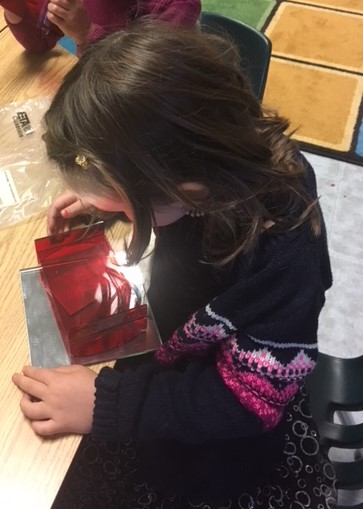
So I launched.  I was ready to start a new unit on light, so I hunted through my house for every flashlight and headlamp I could find.  We were making glow-in-the-dark slime at Scouts, so I grabbed the blue light I'd picked up for that, too. (Although it was really hot, shouldn't probably have been in a K/1 classroom...I'd skip it the next time around).  Then I went hunting for prisms and mirrors, and bits of colored plastic, and bins of "stuff" to shine lights on,  in an attempt to create some provocations. 
                                                     
I had already learned that this group works best with a tiny bit of structure, completely open-ended exploration puts us in proximity with children we don't do our best learning beside.  My solution was to structure the groups and station rotations, but not the exploration specifically.  I set up five stations with a variety of materials and let them rotate through a turn at each.  When we were done, we collected our questions.


We did a lot of thinking during our exploration.  Now my challenge was tweaking the provocations to allow us to explore our wonders.  I spent the better part of an afternoon looking for books at the public library on "light experiments," and googling for "reggio activites about light" and such.  I sorted and re-sorted my bins trying to come up with the best way to present things to answer their questions.

And then I gave up.  I had no idea how to set things up to match their questions.  These weren't my questions.  In the end, I decided to remind them of what their questions were, and to put the materials back out for them, to see what they came up with.  That was a fantastic decision on my part, if I may say so. 

During the exploration, I circulated and ask them about things.  ("Did you find your rainbow?"  "What happened when you stacked those colors together?").  We took a whole bunch of pictures, and put some drawings into our Wonder Books to record our thinking.

I am so proud of these kids.  We didn't all answer our original questions, but we sure learned a lot about light.  Ask us about reflection.  We can tell you that it can "bounce," or go in different directions.  We can tell you that it can change color if we put different, transparent, things between the light source and the place it's landing.

  We can tell you that light goes through some things but not through others, and that it looks different when it comes from a natural source versus a light in the classroom.

We can tell you that it sometimes gets hot, and
that we shouldn't put it right in our eyes or it hurts them. (But that that's better with a barrier like sunglasses).  We have made connections to summer days and solar eclipses.


I love this way of being with learners in the classroom.  It was a leap of faith based on a need to re-design my approach to meet the needs of some very busy little people, and it worked.  I'm always re-directing somebody when we're sitting at the carpet.   When we're exploring with loose parts, I get to talk about wonders and discoveries.  I pack my phone with me because we're so excited we need pictures about everything.  And when we go to put the pictures in our notebook a full week later, we can still describe what we were wondering about and what we figured out.


Thank you, Joanne and Aimee for letting me pretend I knew what you were talking about until I was able to figure out a little bit about it for myself.  It was either rattling out some Loose Parts within myself, or learning about Loose Parts with our learners.  I'm confident that I picked the right set.  I'm far from being an expert on the Reggio approach, but I'm hooked on learning more.  Meeting learners where they are at, and honoring their sense of wonder, is a lovely way to acknowledge that "They Are All Our Kids."

Monday, October 2, 2017

Understanding Intellectual Disabilities

As always, we have lots of new faces in our school this fall.  New learners have arrived at our doors from all over the province and country.  And some of these learners have additional needs that will require adult support and thoughtful planning.

In order to provide the best support we can for these new students, we've been talking lots about what we can do to get to know them and to really understand what they need.  Over the course of these discussions, I've been reminded about how profoundly different it is to provide support for a student with a learning disability than it is to provide support for a student with a more global intellectual impairment.

While both students can struggle with understanding new concepts and "hanging on" to new learning, there are very distinctive reasons for these challenges, and we are only able to provide them with the supports and structures they need if we deeply understand these differences, and why they matter.

 The term Learning Disabilities refers "to a number of disorders which may affect the acquisition, organization, retention, understanding or use of verbal or nonverbal information. These disorders affect learning in individuals who otherwise demonstrate at least average abilities essential for thinking and/or reasoning."(http://www.ldac-acta.ca).

Our learners who have been diagnosed with a learning disability will have an aspect of their learning which is more challenging- perhaps math calculation, or reading fluency, for example, but will have other areas of relative strength, which can help them to develop strategies and to employ tools, to make their challenges less impactful.  Individuals with a learning disability have average or above-average intelligence.  Where we successfully assist these students to learn compensatory skills (work-arounds), they find success with all aspects of the curriculum, heading off to the world of post-secondary education and  work to enjoy life independently and with few barriers.

Often, the tools that are the most successful for these learners are the tools that benefit all learners.  It's not about finding things that are weird or different....it's about providing access to things that EVERYONE benefits from using.  That's the beauty of a differentiated classroom community.

Examples include digital options such as word prediction, speech-to-text and text-to-speech tools, summarizing or hi-lighting tools  (aren't we lucky that between Google Read and Write, Google Chrome and the App Store that many of these things are available free or nearly free for our kids to access!).  Who doesn't want to lay on their bed with a cup of tea and an iPod recording an essay that's easily emailed to the computer for editing...but that's for another post.

The term Intellectual Disability is quite different.  It is "characterized by significant limitations in both intellectual functioning and in adaptive behavior, which covers many everyday social and practical skills." (http://aaidd.org).

Intellectual disabilities are sometimes described as cognitive impairments.  They generally fall into two categories:
Mild Intellectual Disability and Profound Intellectual Disabilities.

Diagnostically speaking, average intelligence is defined as having an IQ (Intelligence Quotient) score of 100.    Individuals with Mild Intellectual Disabilities will have IQ scores less than 70, individuals with Profound Intellectual Disabilities will have IQ scores that fall below 55.

It is easy to see that someone with a profound intellectual disability needs additional help.  These are individuals with such significant communicative and adaptive challenges that it is clear someone is needed to provide support for them on an ongoing basis.

It can be much more difficult to recognize that someone with a mild intellectual disability needs us.  Individuals with mild intellectual disabilities may be slower to acquire new skills and concepts, may find communicating with others or caring for their own personal needs difficult, or may have very short attention spans and be very concrete and literal.  At the same time, they may be quite comfortable in conversation with peers and adults, be able to navigate their school day without someone to help them work their way between environments in the school, and be quite keen to participate in class activities.

What happens sometimes, is that these students are perceived as disorganized, or distractible, or disengaged.  It may be that a student with an intellectual impairment participates in class and seems very interested in the conversation, but is not able to produce assignments without significant adult support.  Perhaps he or she is able to answer the straightforward questions, but becomes overwhelmed and lost when asked to be more reflective or inferential in his or her response.

For me, the most critical thing we can do to support these learners is to always be mindful of the difference between "can't," and "won't."   It is more difficult for learners with an intellectual disability to understand figurative or metaphoric language.  These are students who not be able to process multiple step directions, or to keep track of all of the dates/timelines/bits and pieces that we require of most students in a classroom.  If we're not really careful, it can be easy to think of them as dis-engaged or, (I cringe even typing it), lazy, without remembering all of the very real reasons they may actually be unable to do more without assistance.

These are learners who will have a gap socially with other students.  They will not understand the banter of peer interactions,  or the consequences of some of their choices, in the same way as their same-age peers.   They may be self-conscious about this, or may just become confused and frustrated.   They are definitely more prone to succumbing to peer pressure, it's harder for them to "see things coming."

Often, learners with intellectual impairments require more than differentiated environments or adaptations to their curriculum.  They need specific modifications to the content or expectations with respect to their learning.  They will simply not be able to cope with all of the material that is explored by their peers.


There are some specific things we can do as educators to support this group of vulnerable learners:


1.Support their language skills.  Advance load the vocabulary instruction, and carefully scaffold reading comprehension tasks.  Take time to answer their questions and help them make sense of what they are hearing or reading.  Know that they may not be able to understand or work with the same volume or complexity of material that their peers may explore.
 

2.  Make math manageable.  Basic facts such as arithmetic, time, and measurement will make more sense to students with intellectual impairments.  Problem solving and reasoning tasks will be really tough.  Use visuals, concrete examples, manipulative tools.

3.  Understand that this learner will have a short attention span.  It's not that this learner doesn't want to focus.  He or she actually CAN'T for too long.  Prompts, decreased distractions and starting with the easier bits of the task will help.

4. Directly teach "tricks" to remember things:  little rhymes for rote lists, repeating information orally to oneself, remembering bits of info in clusters, creating little pictures and diagrams.

5.  Help with the transfer of knowledge.  Learning something in English class won't necessarily mean the student can do it in Social Studies.  Wherever possible, teach with meaningful context, point out connections, remind students they learned something in another environment that can help them here. These students will learn new skills and information in little bits.  They need us to break things down, and to help "chain" the bits together. 

6.  Structure opportunities to practice social skills.  These are often learners who won't "get" the interactions of their peers or notice body language.   Coach them.  Encourage them.

(Adapted from https://www.education.com/slideshow/areas-difficulty-children-mild/language-skills/)


For me, though, the most important thing of all is missing off of this list.   Learners with mild intellectual disabilities deserve all of the success, engagement and connection with their school communities that other students experience.  Regardless of the size of their steps, or of whether they are working adaptations or modifications to their curriculum, this group of learners deserve to be working alongside their peers, and their individual learning needs to be acknowledged and celebrated.

After all, THEY ARE ALL OUR KIDS!


Sunday, November 20, 2016

Improving Student Outcomes through Case Study Inquiry

Last year, I facilitated a Case Study Inquiry project with teams from several different schools in the district.

Learning Services teachers partnered with classroom teachers to focus on an individual student they were concerned about, developing a deep understanding of that student's needs and exploring some learning tools and strategies to support that student in moving forward.

A team of us are getting reading to present this work at the Learning Forward Conference in Vancouver next month, so we've been reviewing and reflecting on our journey.  Personally, I've been thinking about my role as an educational leader, and thinking about ways to support teams in continued exploration, in finding ways for last year's learning to sustain itself,   How can I help professional development conversations from last year to become sustained pedagogical practice in the future?

Without exception, the most successful teams shared two key elements:

1.  GENUINELY KNOWING THE STUDENT.
Not just as data, but as a learner, as a person, as a member of the classroom and community.

2.  REAL COLLABORATION.
Regular, open, focused, goal-oriented, data-supported collaboration.


The evolution of the individual teams was really interesting to watch.  When we did our initial introductions in the fall, I asked everyone about their students, so that we could figure out what tools and strategies might be helpful to explore for them.  I was told things like:

  • He's stubborn but likable.
  • She doesn't attend, isn't connected to other students, won't accept help.
  • She has VERY ingrained habits, no initiative for academics.
  • He is constantly negotiating, shutting down and not trying.

When we checked back in at the end of May, the same students were described in this way:
  • He's attentive, kind, empathetic and gentle.  Always seeking connections (with peers).
  • She is developing the courage to take risks, is an independent and active learner.
  • Visual spatial skills are a strength, she is proud of her attendance and math skills.
  • He's creative and has a good sense of humor.  He has lots of oral knowledge and self esteem is happening.  He has his own identity and accepts his autism.

At no point during the year did I ask people to move to a strengths-based lens.  People were not asked to look for strengths, or to "focus on the positive."  I didn't point out that focusing on deficits or challenges made it harder to help these learners.  A strength-based approach just grew.  And was celebrated.

What was responsible for this shift?  How did these teams grow to know their learners so deeply, and move them so far over the course of a school year?  

I believe it was learning how to collaborate meaningfully and regularly.  Each time we got together as a larger learning community, people were asked to provide an update on their focus student.  They were asked to identify areas where their student was having success, and areas where lagging skills were still of concern.  There was a team of us facilitating the large-group sessions, we divided up the questions and focused on areas we thought would be of value to the teams.

At first, it was difficult.  Much of the feedback focused on work habits, attitude toward learning, and learners' challenges.  Undoubtedly this was partly due to the first session happening fairly early in the year, but we could also tell that people had chosen their focus students because they really were seeking some new ideas and strategies.  These were hard kids to figure out.   If they hadn't been, they wouldn't have been chosen for the project.

The team of four (myself, our SET BC District Partner, our Technology Teaching and Learning Resource Teacher, and the SET BC Consultant), poured over the information we'd been given, and determined that the best place to start was with some whole-class tools for instruction.  We needed to help the teams have a way to include their focus student, along with everyone else, into the instruction and lessons.  For this second gathering, we focused on whole-class lessons with Kurzweil, using Google tools and online math resources, and a few flexible iPad apps.  

Next was some more data collection, to see which of these tools had landed, and which ones needed more support or adjustment.  After a survey of participants, we worked to narrow the questions more specifically, visited some classrooms, and tweaked our suggestions/supports in a more individual way for the teams.  We also spent some time considering big ideas and core competencies, and borrowed heavily from Shelley Moore's website resources (blogsomemoore.com).  

We talked lots about "All, Some and Few" as a planning framework, considering the importance of EVERY learner in the room being part of every lesson.  Not in an adapted, or a sit-with-an-EA at the back kind of way, but in a "we-picked-a-starting-point-everyone-can-launch-from" kind of way.  

By our May wrap-up, people requested some specific instruction with more of the Chrome tools and extensions, and were excited to share the progress made by their focus students.  We weren't fishing for questions or guessing at which strategies to share.  The teams came with specific questions to support the learning and collaboration that was already occurring.

Do I believe these four sessions were magical opportunities for collaboration?  No way.  But I do believe that bringing people together over time encouraged them to talk in-between the sessions. There was no way to respond to the surveys and questions without talking to their colleague.  Specific questions in terms of identifying strengths, lagging skills, and questions around what teaching strategies and resources would support them,  encouraged teams to work together to encourage next steps. Folks wanted to have things to celebrate when they got together with the large group.  No one wants to be the team that's got nothing to celebrate.   The only way to show forward movement and success was to work together to create it.


Like most change processes, we hit an implementation dip.  When we got together in January, there was more than one team who weren't sure what they were going to share.  A couple of the students had started off well, but had slipped into old patterns, or non-attendance or frustrations.   But this was a collection of highly professional, dedicated, empathetic educators who weren't stepping away from a challenge.  The teams dug in and worked together to make sure they had some news to celebrate for our April gathering.  They poured over student assignments, reflections & observations to find the spark or connection with their learner.  They looked for new ways to reach their focus students and engage them.

It worked.  Regular, focused conversation about the students and their successes let us focus on the lagging skills in a proactive strength-based way.   All of the students in the project had successful experiences in their classrooms.  The teams noticed that the whole class benefited from the strategies being explored.  Teaching for "all" as a way to include the case study students meant teaching for "all" in the classroom as a whole.  

As for my original question: How can I help professional development conversations from last year to become sustained pedagogical practice in the future?   I have a plan.  I'll keep going.  I'll keep getting to  know teachers and learners.  I'll keep offering support and strategies where I can.  I'll keep seeking ways to provide educators with opportunities for ongoing, sustained, focused collaboration.  And I'll remember the lessons learned from this project.  These learners, and their teachers, have so much to be proud of. This learning community truly understood THEY ARE ALL OUR KIDS.