Our Kids

Our Kids
Showing posts with label mindful learning. Show all posts

Saturday, October 13, 2018

Being Passionately Curious


I saw this on Twitter this morning, and I can't stop thinking about it.  When I went searching for the post so that I could take this screenshot, I saw other examples of it-  but this image with the wings captures my thinking better than any of the other "inspirational picture quote" versions I came across.

I love the vibrancy of this image.  I love that interwoven into this vibrancy is a diverse set of images that span a large cross-section of interests and abilities, thoughtfully interwoven and layered to create movement and energy.  Possibility. 

I think I take issue with it just a little bit-  to me, being Passionately Curious is a special talent.  In fact, I believe the art of nurturing oneself, and others, toward being passionately curious is the most special talent of many educators.  It's what we do when we engage everyone in exploration and foster the sense of wonder the compels all of us to keep reflecting and learning even when the lesson is complete.

It's the bit of bird's nest that comes in after we've looked at habitats in science class.  It's the toppling, sticky-taped, toilet-roll-and-bent-straw ramp that shows up after we've talked about forces and gravity.  It's the outlandish-but-interesting connection that someone offers during lit circle that we keep talking about all week.  It's the Reggio Inspired primary program that has little ones building, creating, inventing.  It's inquiry, and maker-space, and innovation and problem-based learning. 

But it's not just for our kids.  It's for us, too.  It's finding ourselves in deep in the cupboard looking for solo cups or shimmering elastic thread because the perfect community building lesson dawned on us when we woke up at 3 in the morning still thinking about yesterday.
It's the gathering of 2-3 colleagues to plan a special activity, or outing, or buddy project because we're all excited about the same thing.  It's also the energy that builds after reflection on student work samples, or assessment data, and we begin moving forward as a school team in crafting an approach to help propel our leaners to the just-right next place.

I'm not the first person to be inspired by this notion.  A bit of a websearch around this idea landed me some pretty interesting websites to explore almost instantly-  check out the Passionately Curious Kindergarten, the work being done at UBC regarding Transformative Educational Leadership.  or even the goings-on at Science World.

It's such a fantastic time to be a BC Educator.  Embracing a competency-based approach with open-ended exploration is the very best way to be passionately curious students and adults.  Every day, I am blessed to wander throughout my building and hear the buzz of learners and teachers co-creating learning opportunities and exploring ideas together.  It's pretty special to be passionately curious as a community.  And it works. Our learners move forward together when we engage them in what they are curious about as individuals.  Good thing, because They're All Our Kids!


Sunday, April 22, 2018

Career Life Exploration

I've been thinking a lot about this transition-to-adulting business.  I have a son graduating from high-school this year, and he's really struggled to carve a pathway for himself, so I've been watching the evolution of the new high-school Career Education curriculum with interest.

Educators have always been invested in preparing kids for the future, but they've not always produced the results they hoped for.  Some of our kids have made the most of the opportunities available to them...they've explored work experience, gone to job fairs, done campus tours...they have amazing scholarship applications, resumes and cover letters, and know exactly where they're headed.

Other kids are more like my son.  They know how to "do high-school,"  but are pretty overwhelmed by the idea sifting through the possibilities that exist after graduation.  They collect pamphlets and course catalogs at University Fairs without talking to anyone.   They wait to apply for jobs, or scholarships, or schools, because they don't know how to make sense of their options.   As June 30 approaches, making decisions feels even higher-stakes, and it starts to feel safer to avoid making a decision at all, rather than making the wrong one.

This spring, I've been lucky enough to participate in a district conversation about Career Education at the same time I've been watching my son and his friends navigate their last semester of high school.  It's struck me that part of what's happened for a couple of them is that for them, career exploration has been a series of "moments," rather than a journey.  A cool visual resume in grade 9.  "Checking off" Planning 10.  Completing a Grad Transitions package in grade 12. 

(Below is my first go at a Sketchnote for public consumption.  Pardon the rustic drawing, but it captures my take on what the new curriculum for Career Life Exploration (gr. 10) is all about...)


I am super excited to be part of a conversation around building Career Education as a seamless continuum.  I love that this continuum will begin in grade 8 and keep building until graduation.  Students will have opportunities to explore their career pathway in a variety of environments-  embedded in other courses (for example, financial literacy in mathematics, resume and scholarship writing in English, person sexual health and social media literacy in physical education).  It'll never be "done."  They'll keep adding layers of understanding and experiences as they go.  Recursive reflection as they learn more about themselves and the world. 

As adults, we know that we didn't need to know everything we would do for the next 30 years on the day we graduated from high school.  We know that we can make a decision that's the right fit "for now,"  without committing to "forever,"  and that building our personal network and skills will help us create opportunities for ourselves down the road, even if we're not 100% sure which road we're taking.  We know the value of  balancing work and life, of being aware of global trends and our own talents and skills.

It's a gift that I am able to work with my colleagues to build opportunities for our students which will encourage them to do the same. 

My son now has a plan he's looking forward to.  After several months of wondering why he had to make a decision before the summer, and trying to find a way out of the Bachelor of Science his mother strong-armed him into applying for in February, he's been accepted into Culinary Arts at VIU.   He weighed his options, he's made a commitment to the next year that he's excited about.  He's trusting that this leap of faith will be a positive experience and will give him some skills that he can use in the future. 

I'm proud of him.  I'm excited for him.  But,  I can't help but think that this year of agonizing would have been a little bit easier, the options a little bit clearer, if he'd started thinking about them much earlier in his journey.  I know most people apply for Dual Credit programs with less than 12 hours to go on the application deadline.  But I also know he wasn't the only one of his friends completing the application the same day he was. 

We have students who have a clear goals and a plan to meet them much earlier.  They know they've "always" wanted to be an archaeologist, or a doctor, or a dancer.  But I would argue that isn't the case for everyone.  And I can't help but think that this new framework will most help those who need more support.   We have much to be optimistic and excited about.  I know I'm excited that I get to be a small part of it.  After all, They're All Our Kids.


Saturday, November 18, 2017

Why I Love Loose Parts

This has been an interesting fall for me.   I am back in the classroom on a regular basis for the first time in many years.  Each Wednesday morning, I have the privilege of working with a group of kindergarten and grade 1 learners.

I can't really say whether or not they are a "typical" group, as it's been 15 years since I was last a kindergarten teacher.  I can say they are busy.  They're curious.  They're creative.  They're conversational.  And several of them are still learning the basics in terms of sharing their learning space with others and interacting successfully as part of a group.

I've struggled a bit to find a rhythm with them.  They've got too much energy to sit for stories and whole group lessons, they are all over the place in terms of their readiness for product-based tasks.  Solving a challenge that one is having inevitably leads to something that needs sorting with someone else.

I've been chatting with my teaching partner, who is with them for the other 90% of the week.  She has set up these wonderful morning choices for them, and she never seems to be as rattled as I'm feeling after a busy morning with our class.  She talked about provocations and seeing where their questions took them. 

I knew the feeling in the room during this choice time was lovely and productive, but didn't know that was rooted in Reggio Emilia philosophy until another teacher on our primary team came across the hall and began chatting about "Loose Parts."    She's working on her masters, and was doing a project on them.  I listened along, hearing all kinds of wonderful things about creativity, and interest, and engagement, and honoring children's passions. I admitted that I was new to this approach, but didn't confess that I had no idea, really, what a "loose part" or a "provocation" were. 

That weekend, I went home and did a whole bunch of reading.  I learned that provocations were clues alongside bits of materials or objects that are designed to inspire exploration.  Not "rules" or "systems,"  but something that can provide "an inspiration for children to express themselves." (From: What is a Provocation).  I love this idea.  We were expressing ourselves all over the classroom.  Might as well find a way to channel it for good...

I also read about how to set up a "Reggio-Inspired Activity."   From what I have gleaned through my reading, you begin first with the children.  Find out what they are interested in, what they have questions about.  Once you know that, you seek activities and materials that will "engage their sense of wonder."  How beautiful is that notion?  If we can do that, even a little bit, what a wonderful place our classrooms will be.  Kate Gribble's blog has really helped me think through this...you can find her at: An Everyday Story: Inquiry Based Learning. 

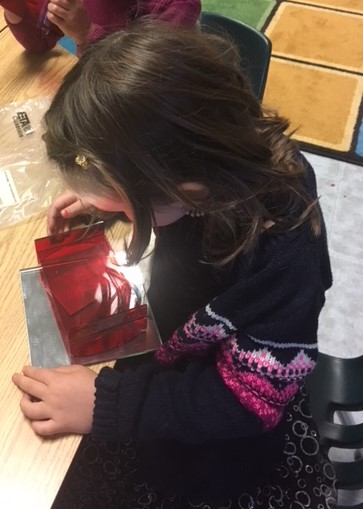
So I launched.  I was ready to start a new unit on light, so I hunted through my house for every flashlight and headlamp I could find.  We were making glow-in-the-dark slime at Scouts, so I grabbed the blue light I'd picked up for that, too. (Although it was really hot, shouldn't probably have been in a K/1 classroom...I'd skip it the next time around).  Then I went hunting for prisms and mirrors, and bits of colored plastic, and bins of "stuff" to shine lights on,  in an attempt to create some provocations. 
                                                     
I had already learned that this group works best with a tiny bit of structure, completely open-ended exploration puts us in proximity with children we don't do our best learning beside.  My solution was to structure the groups and station rotations, but not the exploration specifically.  I set up five stations with a variety of materials and let them rotate through a turn at each.  When we were done, we collected our questions.


We did a lot of thinking during our exploration.  Now my challenge was tweaking the provocations to allow us to explore our wonders.  I spent the better part of an afternoon looking for books at the public library on "light experiments," and googling for "reggio activites about light" and such.  I sorted and re-sorted my bins trying to come up with the best way to present things to answer their questions.

And then I gave up.  I had no idea how to set things up to match their questions.  These weren't my questions.  In the end, I decided to remind them of what their questions were, and to put the materials back out for them, to see what they came up with.  That was a fantastic decision on my part, if I may say so. 

During the exploration, I circulated and ask them about things.  ("Did you find your rainbow?"  "What happened when you stacked those colors together?").  We took a whole bunch of pictures, and put some drawings into our Wonder Books to record our thinking.

I am so proud of these kids.  We didn't all answer our original questions, but we sure learned a lot about light.  Ask us about reflection.  We can tell you that it can "bounce," or go in different directions.  We can tell you that it can change color if we put different, transparent, things between the light source and the place it's landing.

  We can tell you that light goes through some things but not through others, and that it looks different when it comes from a natural source versus a light in the classroom.

We can tell you that it sometimes gets hot, and
that we shouldn't put it right in our eyes or it hurts them. (But that that's better with a barrier like sunglasses).  We have made connections to summer days and solar eclipses.


I love this way of being with learners in the classroom.  It was a leap of faith based on a need to re-design my approach to meet the needs of some very busy little people, and it worked.  I'm always re-directing somebody when we're sitting at the carpet.   When we're exploring with loose parts, I get to talk about wonders and discoveries.  I pack my phone with me because we're so excited we need pictures about everything.  And when we go to put the pictures in our notebook a full week later, we can still describe what we were wondering about and what we figured out.


Thank you, Joanne and Aimee for letting me pretend I knew what you were talking about until I was able to figure out a little bit about it for myself.  It was either rattling out some Loose Parts within myself, or learning about Loose Parts with our learners.  I'm confident that I picked the right set.  I'm far from being an expert on the Reggio approach, but I'm hooked on learning more.  Meeting learners where they are at, and honoring their sense of wonder, is a lovely way to acknowledge that "They Are All Our Kids."

Thursday, August 3, 2017

Lessons Learned in Porlier Pass


My husband and I had an eventful paddling excursion last week.  As you read this, keep in mind that we already know that we were out there lacking some of the knowledge we needed.   We were definitely lacking the experience we needed.  The day was significantly longer than what we needed. Those were the "instant lessons" learned.

As in most circumstances where I find myself in way over my head about something, I start digging for the silver lining, the bit of learning that I can bring forward to make things easier next time.  As we brought the kayak onto the beach 30 km and 10 hours later, I looked at my husband wryly, and said, "there's a blog post in here somewhere."

No way was I going through a day like that and not garnering something of value from it.

If you're a water enthusiast, please pardon the basic definitions that follow.  They're alot more meaningful to us now than they were a week ago.

Slack tide:  that time between high tide and low tide where the water is calm and current at it's minimum.  It's tight window. About 40 minutes in Porlier Pass, between Galiano and Valdez Islands.


Flood tide:  when the tide is coming in.  In Porlier Pass, it means the water is heading back to Salt Spring.


Ebb tide:  when the tide is retreating from the shore.  In Porlier Pass, it means the water is heading out of the pass toward Vancouver.  


Flood and Ebb tides in Porlier Pass both look a bit like a fast-moving river.  In telling our story since returning home, my husband has taken to referencing it  as "the maelstrom."


Intuitive readers are already going to have identified that this was some of the deep learning that we hadn't quite solidified on our way to the Dionisio Point campground last week.  We had done some research, knew the water could be quite different at different times of day, and had planned to head in at slack tide.  We have a healthy respect for the water, and had saved tons of extra time, and had lots of extra food as well as our sleeping bags, in case we ended up needing to spend the night.  We had checked and re-checked the tide table before we headed out.

Yet, 3 1/2 hours into an already challenging paddle-  strong currents are found throughout the Trincomali Channel -  as we entered Porlier Pass under glorious sun for our picnic -  we didn't truly understand how quickly things would change.  After a 15 minute munch, (under the only cloudy skies we had the whole four days we were away), we looked back at the way we'd come, to see a vastly different body of water.  It turns out that most of the "slack time" is in the lead-up to the published time for slack tide, not after it.

Before putting the kayak back into the water, we walked out to the point to peek around the corner, and found a roiling boil of swirling whirlpools and what looked like a fast moving river, heading the opposite direction of where we wanted to go. We knew it was 6 1/2 hours before the next slack tide. The actual campsite was a bit further around the point that we'd anticipated, so our picnic spot had actually been rocky shelf,  about 500 m shy of the spot we had originally planned to go to, and was somewhere that wouldn't really be great for camping,  so we decided to go for it and see what happened.  The plan was to stick right along the shoreline and chip away at things bit by bit.  If necessary, we'd pull in along the way and spend the night.

That worked to get us through the really fast moving water right at the point.  We got through the first bit more easily than we expected.  Right up until the kayak got wedged on some shallow rocks.  After rocking side-to-side for a bit to loosen ourselves, and launching off of the rock we backed into, we shot into the middle of the pass.

By now, our clear heads were a little less clear.  We got this idea that the water looked smoother in the middle, so we stayed there, rather than heading back towards the shoreline.  We paddled like crazy to get ourselves out the mouth of the pass.  Forty-five minutes later, when we realized that the landmarks right beside us hadn't changed, (except for when we took turns having a sip of water and shot backward 100ft), it was time for a new plan.

We took a hard right turn to tuck in behind some rocks to regroup. A short breather there let us brainstorm another plan.  There was a second out-cropping of rocks right at the mouth of the pass a little further north, we decided to leapfrog to that.  We did a full 360 in a whirlpool on the way, but safely got behind it.  My husband stepped out to see what that last point looked like- we decided to hug one more corner in the kayak, rather than portaging, and went for it.

This time we made it, and headed to a beach at the southern tip of Valdez Island.  Heading north instead of south added about 7 km to our paddle by the time we would get back to Salt Spring,  but we were finally in safer water, and knew we'd be able to make it back before dark.

I'm not telling this story as a celebration of our kayaking prowess. There's no doubt we were in way over our heads and need to be a lot smarter when out on the ocean in the future.  There's a reason why people go into Dionisio at slack tide, stay over, and leave the next day, at a new slack.  Clearly our misunderstanding the difference between the direction of the water at ebb and flood meant we could have sent us halfway to Vancouver rather than propelling us out to Triconomali after lunch.

But I think I've found a pretty good metaphor for the changes coming for me in the fall.  After 20 years in the Qualicum school district, with the last 5 1/2 in district learning services, I'm moving back into a school-based admin role, with Nanaimo-Ladysmith Public Schools.  I have plenty of learning to do.  Not only do I need to develop and understanding of the district's systems and processes, I'll have TWO school communities to learn from - one elementary and one secondary.

I've been doing some research this summer.  I've had tours of the schools and met the principals I'll be working with at both sites.  I know a little about the schools' goals and focus, as well as the initiatives that the two teams have been working on.  My husband is already with the school district, so I know a little bit about the processes and overall district culture and vision.

It's like paddling in slack tide.  I'm armed with information and I'm moving forward, but without experiencing it first-hand, I don't really know what the waters ahead will bring.  I don't know where the periods of calm will be, nor do I know when the whirlpools and fast-moving current of the flood and ebb tides will start to pull me somewhere unexpected.

Like paddling in the heavy currents of the pass, I need a plan that provides me with a way to collect the information I need, as well as the moments to pause, to reflect, and to correct course, if I'm to be successful in this transition.

I've decided to draw a springboard for this plan from the Leadership Symposium I attended with Sandra Herbst and Anne Davies in early July.   We spent 2 1/2 days talking about ways to "become a system of Master Learners."

Over the course of the session, Anne, Sandra and their team encouraged us, as a group of educational leaders, to consider evidence of being master learners in our own practice.    We were asked to reflect on how our own work aligned with that of the broader system- both at the school level, and at the district level, and to consider "are you owning or renting the work?"

I believe that to successfully navigate the complex tides of the coming school year,  I need to work toward becoming a master learner, to soak up what I can of the new culture and seek opportunities to contribute to my new environment in thoughtful, deliberate ways.  Anne and Sandra call this "Assessment in the Service of Learning."   

They argue that to do this, leaders must deliberately and systematically collect data as evidence of specific goals.  This data, must take a variety of forms-  

a) products - samples of student learning, quantitative data; 
b) conversations - with teachers, students and parents, and 
c) direct observation of learning activities - by both adults and students.  

Looking for the patterns and connections in this data (triangulation), will create a picture of progress toward those goals, and help to identify the areas where additional work needs to be done.


Once I decide on my focus goals, (which I will narrow down after I learn more about the goals and focus of the schools and district), I will begin to collect evidence and build myself a portfolio.

The digital portfolio I started a few years ago is a repository.  An electronic photo album of bits of writing and PowerPoint presentations from workshops I've hosted, illustrating where my thinking was at at the time the samples were generated.  It's a good definition of my beliefs and philosophy regarding my role as an educator.

My new portfolio will be far more focused and organic.  It's not that the things I've collected are irrelevant-   in fact, I believe they're a great snapshot of my learning over time - but they are not focused on my current journey of  becoming a master learner.  They are not focused on Assessment in the Service of Learning with respect to the specific goals and objectives of the schools and district I will be working in next year.   The "umbrella" goal of my revised portfolio will be to help bring me into alignment with my new environment.

By collecting valid, reliable, evidence in multiple ways,  I'll be able to see progress toward my personal goals.  If these personal goals are drawn from the goals of the school and district, I will be in alignment with the bigger picture.  This should help me to find ways to contribute to the work being done both in classrooms in my own schools, and across the district.

Anne and Sandra suggest three questions to help focus the reflection that follows this evidence gathering:

What counts?
What matters?
What's important?


Creating this portfolio will also give me an opportunity to provide what Anne and Sandra describe as "tight support and loose pressure."  If I'm becoming a master learner, I will recognize that collecting data is not simply to help me complete a tick-box-  it's a way to check-in and learn how things are going in a deep and meaningful way.  Once I am more informed about the status of the initiatives and student learning in my schools, it will be easier to encourage myself, and my team, to keep moving forward.  And it will compel me to provide whatever support and encouragement I can to make further growth happen.

My husband and I were in over our heads when we paddled out of "the maelstrom."    Our focus and goal shifted significantly over the course of the day.  In collecting bits of evidence as things unfolded, we adjusted our plans and strategies- and our perspective on what counted, what mattered, what was important.   It wasn't until we deliberately sought calmer waters and really took stock of our environment and our learning to that point when we were able to adjust our goal and make a plan that led to a successful adventure.  It also very clearly pointed us in the direction of additional learning we need to do.

That's the bit I'll take with me in this transition. The deliberate collection of evidence in a portfolio, and intentional stops in the year to reflect on what I've learned, will allow me to construct that moment in calmer waters to take a look around my environment and to consider the variety of options and pathways available to me, helping me to make the best decision I can in moving forward at that point in time.  To provide both myself, and my team, with that tight support and loose pressure toward our goals.

In becoming a master learner, I will better be able to serve the students and staff of my new school communities.  Because, they're all our kids.


Monday, April 17, 2017

Assessment in the Service of Learning

It's funny how, every once in a while, everyone seems to start talking about the same thing at the same time.

This spring, I've been reading and reflecting on ways to utilize student self-assessment for evaluating the new Core Competencies in the BC Redesigned Curriculum.  Earlier in the year, I challenged our district's team of learning services teachers to write "competency driven IEP goals."  We spent time looking over the profiles for each of the competencies, and talked about ways that this work is linked to classroom programs.  We talked about ways to embed this work into things the students are already working on, and how we could collaborate with classroom teachers to make it happen.

It was a lofty goal, and we knew it was a "process,"  not a "moment."  

Fast forward 6 months, and now we're faced with the task of evaluating progress toward these goals, and starting our planning for next year as we review the current Individual Education Plans. Thus, my hunt for tools/suggestions/supports to offer to the team in our conversations.

I've come across a couple of things that I believe are useful in this quest.


1.  Kallik and Zmuda's book Students at the Centre. 

In it, the authors talk about four aspects of self-assessment to engage students:  co-creation of goals and steps toward them; finding their voice in sharing their work with each other, teachers, and parents; building ideas through relationships (social construction), and coming to understand themselves as learners through self-discovery.  


The text goes on to describe the 16 Habits of Mind that are characteristics for students' success, and provides examples of assessment strategies and rubrics for promoting student growth.


2. Successful Learner Traits:

School District 71 (Comox) began this conversation, but it's gaining traction across the province because of the flexibility of the framework, and the many, many ways it can be integrated into classrooms for students of all ages.  It supports learners towards being mindful of their approach and the way they apply themselves to various tasks.  The list is similar to the list of Habits of Mind above-  and is captured on a variety of colorful posters featuring different animals.  Strategies for Assessment for Learning are embedded throughout the materials.  (Click the photo to link to the website).


3.  In Grading, Reporting and Professional Judgement in Elementary Classrooms, (as well as in their companion book for the secondary school setting),  Sandra Herbst and Anne Davies share some  perspective on ways to prepare students and teachers to engage in self-assessment, and encourage teachers to collect "triangulated" data....from work samples, from observations of students, and from conversations with them.  

Herbst and Davies describe Assessment for Learning as "Assessment in the Service of Learning."  I love this.  It fits beautifully with my belief that educators are advocates for all students, and that we need to teach all students to be advocates for themselves.  Everything we say, do, experience, in school, has an aspect of service built it.  I'm a Scout.  This works for me.  

I enjoyed these texts while I was working through them, but it wasn't until I had the opportunity to sit in a session with them,  and they emphasized a few key ideas, that the deep meaning of what they were really saying, fully landed. 

They challenge us all to consider:

How can we put students at the center of pedagogical reflection?

In what ways does capturing evidence allow us to better know our learners?  

(Because Professional Judgement is not "trust me, I'm a teacher.  It's informed decision making based on solid evidence.)

They offered suggestions-  such as tools for collecting observational data, proof cards, and apps such as Aurasma and SeeSaw - to help us collect evidence beyond work samples in a seamless way.  For a deeper look, their website, Connect2Learning has lots of great tools and ideas available for educators to use.  


This brings me to the personal part of my reflection.  In sitting in the session with Herbst and Davies, I also realized there was so much more I could be doing as a leader to support my team in developing a deep commitment to student self-assessment of the competencies.  

So far, I have shared a collection of articles and artifacts.  I've spent time developing rubrics and participated in "group marking sessions" with colleagues.  I've reviewed IEP goals with teams and helped to tweak the language and determine assessment tools that matched.  I've modeled self-assessment strategies when teaching lessons in classrooms.

In every case, I was modelling and supporting things for others to do, but I wasn't really owning the journey for myself.   I've been saying for ages that it's really difficult to maintain a connection to classrooms and students when working in a district capacity, yet I now realize I've missed the first step in changing this.  While I've spent lots of time thinking about how to help and support others, I haven't worked nearly hard enough at helping and supporting myself.

Herbst and Davies challenged all of the administrators in my district to engage in their own learning and exploring of the tools as a way to model effective practice for others.  If you've not engaged in students in self-assessment in an embedded, authentic way, it's a leap of faith to implement things that will result in very different types of data than has been collected in the past.  If, as an administrator, it is my hope that the educators I work with will engage in this type of practice with their learners, then I should be authentically doing it myself.  


How have others modeled this journey as administrators?

- By creating a bulletin board of photos, work samples, and transcribed conversations, that support the school's journey toward the school goals
- By blogging....not just about personal areas of exploration, as I have been doing, but in response to specific goals and areas of growth
- By creating a personal e-portfolio of learning towards a professional growth plan, and sharing it with staff
- By being a part of classroom environments-  not just for a walk-through, but by practicing new things alongside a colleague
- By working with admin colleagues to practice offering deep feedback to teachers, and receiving/reflecting on deep feedback ourselves in terms of how effective this feedback is.

So.  I've decided to embark in my own process of Self Assessment for the Service of Learning. Herbst and Davies say that that getting going means taking the first, next, step.  I need to take two.

First....I'm going to begin transforming my e-portfolio.  I have one, but it shows where I've been.  It needs revamping to show where I'm going.  I will work on a goal and some plans for stepping toward it, so that it's all ready for the exploration that will follow.

Second...I'm going to find myself two critical friends.  One who is a classroom practitioner who is willing to let me come in and explore alongside next year.  Together, we can pick something to work on and begin crafting our pathway toward it together.    The other is an admin colleague who is willing to offer feedback on my journey, to help me reflect the learning I will do as I deepen my own understanding of self-assessment and using the competencies enhance student learning.

Assessment in the Service of Learning.  It's worth it, because They're All Our Kids.