Our Kids

Our Kids
Showing posts with label self-regulated learning. Show all posts

Saturday, November 18, 2017

Why I Love Loose Parts

This has been an interesting fall for me.   I am back in the classroom on a regular basis for the first time in many years.  Each Wednesday morning, I have the privilege of working with a group of kindergarten and grade 1 learners.

I can't really say whether or not they are a "typical" group, as it's been 15 years since I was last a kindergarten teacher.  I can say they are busy.  They're curious.  They're creative.  They're conversational.  And several of them are still learning the basics in terms of sharing their learning space with others and interacting successfully as part of a group.

I've struggled a bit to find a rhythm with them.  They've got too much energy to sit for stories and whole group lessons, they are all over the place in terms of their readiness for product-based tasks.  Solving a challenge that one is having inevitably leads to something that needs sorting with someone else.

I've been chatting with my teaching partner, who is with them for the other 90% of the week.  She has set up these wonderful morning choices for them, and she never seems to be as rattled as I'm feeling after a busy morning with our class.  She talked about provocations and seeing where their questions took them. 

I knew the feeling in the room during this choice time was lovely and productive, but didn't know that was rooted in Reggio Emilia philosophy until another teacher on our primary team came across the hall and began chatting about "Loose Parts."    She's working on her masters, and was doing a project on them.  I listened along, hearing all kinds of wonderful things about creativity, and interest, and engagement, and honoring children's passions. I admitted that I was new to this approach, but didn't confess that I had no idea, really, what a "loose part" or a "provocation" were. 

That weekend, I went home and did a whole bunch of reading.  I learned that provocations were clues alongside bits of materials or objects that are designed to inspire exploration.  Not "rules" or "systems,"  but something that can provide "an inspiration for children to express themselves." (From: What is a Provocation).  I love this idea.  We were expressing ourselves all over the classroom.  Might as well find a way to channel it for good...

I also read about how to set up a "Reggio-Inspired Activity."   From what I have gleaned through my reading, you begin first with the children.  Find out what they are interested in, what they have questions about.  Once you know that, you seek activities and materials that will "engage their sense of wonder."  How beautiful is that notion?  If we can do that, even a little bit, what a wonderful place our classrooms will be.  Kate Gribble's blog has really helped me think through this...you can find her at: An Everyday Story: Inquiry Based Learning

So I launched.  I was ready to start a new unit on light, so I hunted through my house for every flashlight and headlamp I could find.  We were making glow-in-the-dark slime at Scouts, so I grabbed the blue light I'd picked up for that, too. (Although it was really hot, shouldn't probably have been in a K/1 classroom...I'd skip it the next time around).  Then I went hunting for prisms and mirrors, and bits of colored plastic, and bins of "stuff" to shine lights on,  in an attempt to create some provocations. 
                                                     
I had already learned that this group works best with a tiny bit of structure, completely open-ended exploration puts us in proximity with children we don't do our best learning beside.  My solution was to structure the groups and station rotations, but not the exploration specifically.  I set up five stations with a variety of materials and let them rotate through a turn at each.  When we were done, we collected our questions.


We did a lot of thinking during our exploration.  Now my challenge was tweaking the provocations to allow us to explore our wonders.  I spent the better part of an afternoon looking for books at the public library on "light experiments," and googling for "reggio activites about light" and such.  I sorted and re-sorted my bins trying to come up with the best way to present things to answer their questions.

And then I gave up.  I had no idea how to set things up to match their questions.  These weren't my questions.  In the end, I decided to remind them of what their questions were, and to put the materials back out for them, to see what they came up with.  That was a fantastic decision on my part, if I may say so. 

During the exploration, I circulated and ask them about things.  ("Did you find your rainbow?"  "What happened when you stacked those colors together?").  We took a whole bunch of pictures, and put some drawings into our Wonder Books to record our thinking.
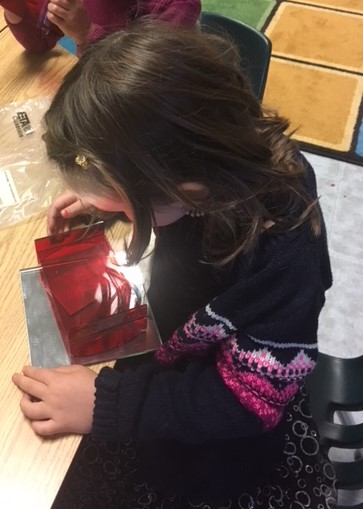
I am so proud of these kids.  We didn't all answer our original questions, but we sure learned a lot about light.  Ask us about reflection.  We can tell you that it can "bounce," or go in different directions.  We can tell you that it can change color if we put different, transparent, things between the light source and the place it's landing.

  We can tell you that light goes through some things but not through others, and that it looks different when it comes from a natural source versus a light in the classroom.

We can tell you that it sometimes gets hot, and
that we shouldn't put it right in our eyes or it hurts them. (But that that's better with a barrier like sunglasses).  We have made connections to summer days and solar eclipses.


I love this way of being with learners in the classroom.  It was a leap of faith based on a need to re-design my approach to meet the needs of some very busy little people, and it worked.  I'm always re-directing somebody when we're sitting at the carpet.   When we're exploring with loose parts, I get to talk about wonders and discoveries.  I pack my phone with me because we're so excited we need pictures about everything.  And when we go to put the pictures in our notebook a full week later, we can still describe what we were wondering about and what we figured out.


Thank you, Joanne and Aimee for letting me pretend I knew what you were talking about until I was able to figure out a little bit about it for myself.  It was either rattling out some Loose Parts within myself, or learning about Loose Parts with our learners.  I'm confident that I picked the right set.  I'm far from being an expert on the Reggio approach, but I'm hooked on learning more.  Meeting learners where they are at, and honoring their sense of wonder, is a lovely way to acknowledge that "They Are All Our Kids."

Friday, June 9, 2017

Grappling with Meaningful Inclusion

This has been an interesting spring for me.


I am someone who advocates for ALL students to be welcomed and included in learning environments across the district.  I define myself as an inclusion advocate, engaging in problem-solving and planning conversations all the time.  I visit classrooms and teach model lessons to help classroom teachers envision ways to differentiate and provide multiple points of entry so that all students in their learning community participate in meaningful ways.


This year, I was challenged with supporting a couple of school teams who were really struggling provide a meaningful school experience for two learners who are on the autism spectrum, are non-verbal, and who have significant challenges with self-regulation.  Not regular challenges with self-regulation. The kind of challenges that led to two adults working with each of these children at all times, and programs that had evolved to the point where these children were essentially isolated in a separate space with those adults for the bulk of the day.


This was really hard for the dedicated, empathetic, creative teams working with them.  Each and every person- and I do mean everyone - classroom teachers, learning support teachers, education assistants, administrators, parents, itinerant specialists and outside consultants - supporting these children wanted more for them.  Success timetables with opportunities to learn and grow alongside peers had been developed for most every environment, indoor and out, for these students.  The speech-language pathologists had developed high and low-tech communication devices for them, there was a clear and workable structure for a visual schedule and transitions.


We just couldn't get there.  These learners are incredibly complex, and we learned, over time, that their significant sensory needs currently impair their capacity to be safe and successful in typical learning environments.  Even in the spaces that had been set up for them in their home schools, they were exposed to bells, announcements, lighting, noises, large groups of moving children, and even "funny smells" from hot lunch and cooking programs.  We just couldn't get the recipe right for them.

After many, many, parent meetings and conversations with the teams at both home schools, we decided we needed to do something different.  We needed a place where we could focus on these students' needs, and systematically build in interventions and opportunities, especially tailored for them to build capacity with the skills they needed to be successful in their home school environments. We needed a facility that provided opportunity for practicing learning behaviours in a classroom, for up-regulating (our sensory room), down-regulating (our quiet room), and easy access to the washroom.    We needed to be able to work through the challenging moments that would be needed in a way that allowed these students to scream, to cry, to sleep, to explore, to succeed, in a respectful, open way, while keeping everyone, both students and adults, safe while this practice happens.


Thus Bridges was born.


Over spring break, we relocated some of the Learning Service offices to vacate a four-pack of learning spaces that were ideally arranged for this type of supportive environment.  We ordered equipment, found a teacher, enlisted the help of some education assistants who already knew the children from their previous environments, and got things going.

Right after the break, these two students began to attend this new centre.  It feels like the successes are building.  The team of adults has worked tirelessly to create a warm environment.  The classroom is full of literature, and displays of student work (I love the sensory-friendly bulletin board of actual artifacts they created on a recent nature walk).  They have bean bag chairs and soft lighting, they have a kitchen table to gather at for meals and snacks,  and they have a lot of fun creating special events for their class. (My favorite so far was May the 4th Be With You - Star Wars t-shirts and alphabet, an awesome quote from Yoda on the door).


I'm not going to pretend we haven't had difficult days.  Of course we have.  When you're supporting learners as complex as these young people, you will always have things to work out and wonder about.  But overall, the families are thrilled their children are able to be at school all week, to learn alongside a peer, to participate in field trips, and to have the time and space they need to have their individual needs supported along the way.
But that's not really what this post is about.  This post is about the gnawing niggle in my stomach that I've had since the moment Bridges opened it's doors.  I'm awfully proud of the work being done in there.  I can't even believe how fantastic the team of adults is -  taking every moment in stride, continually reflecting on next steps, or considering antecedents or triggers for the challenging moments that erupt on a daily basis.


So if Bridges is successful, why can't I just relax and celebrate?
It's because I struggle, every day, with how this matches with my beliefs about inclusion.  If I believe that teachers need to teach for ALL, that classrooms need to provide multiple points of entry for ALL, that They're ALL our Kids, how can I be ok with having two students leave their home schools, their neighborhood schools, every day, to attend this off-site environment?


After attending the BC CASE conference last month, and being lucky enough to listen to several educators whom I have immense respect for, I've landed on a couple of thoughts that are helping. 


1.  It's about having a PURPOSE within the PLACE.  (Thanks, again, Shelley Moore).  You're right.  Students need to have something meaningful to DO in the place they are learning.  We need to create meaningful opportunities for them in the learning environments they encounter.  Because of the challenges these young learners currently experience, we couldn't do that in their previous environment.  They are not yet able to regulate in a safe enough way to be with other children in a busy, or even a quiet, space.  This led to dangerous situations, sometimes resulting in injury, in their previous settings.


Bridges is a PLACE that meets them where they are at, giving them opportunity to practice being self-regulated learners in an environment that has all of the additional supports and tools, and access to specialists, they require if we are going to help them to develop these skills. Their PURPOSE is building the skills they need to Bridge (pun totally intended) back to their home schools when ready.


2. It's about COMMUNITY.  It's not enough to say we're doing "Social Inclusion" by allowing them to warm a seat at a table somewhere within a room full of others.  (Thank you, Pat Mirenda.)These children deserve an opportunity to develop friendships and connections with peers.  Things were very difficult for them in a larger school environment.  They were too overwhelmed to connect with peers, or "big buddies."    Their whole experience was structured around the adults setting up opportunities for them to interact in safe ways-  which meant there was most often an adult "buffer" between them and other learners.  Now they take turns with activities in their new classroom. They sit together to eat their meals.  They go on weekly field trips to the library, daily walks on the nature bath.  They get Star Wars day.


3.  It's about the WHOLE CHILD.  If we're really wanting meaningful opportunities for our children, we need to provide meaningful learning opportunities (#1), to fostering a sense of belonging in a social community (#2).  And we need them to feel a sense of self-worth, of success, in their experience.  (Thank you, Jennifer Katz.)  While they're at Bridges, these learners interact with one another, with the adults in their classroom, with older students who visit and read or do art projects with them, with their community on field trips.  There is enough space and time to notice each little success and celebrate it.  There is enough space and time to sit and wait for them to think about next steps, to process decisions, to "plunk down" on the path and work something out for 10 minutes, if that's what they need.   Every day, every task, gives us a chance to learn more about these children, and to adjust and scaffold what's next.  Their environment allows us to pace things in a way that honors and respects their highly individualized journeys.


So, now I have three suggestions or thoughts I can offer when challenged to describe Bridges as an inclusive place. I am proud of Bridges because I see how supportive and successful it is being for these learners.


I'm glad that the gnawing niggle in my belly remains, though.  This environment was created as an INTERVENTION for some children who really needed another way to approach their learning.  It's not a "new school."


We need to always be mindful of our end goal - self-regulated learners who have developed the skills and capacities to return to find a purpose within a place back with their peers in their neighbourhood schools.  That is the purpose of this place.  The moment we move away from that, and become complacent, or accept this type of intervention as a "necessity," without looking ahead, we've missed the point.  We have a moral obligation to provide meaningful opportunities every day for every learner, in the most inclusive way possible.  This intervention, like all intervention, needs to be goal-focused and time-limited. 


Bridges is an inclusive environment for learners who were isolated in their previous settings. These learners experience opportunities that allow for that challenge, support, community and celebration in their daily school experience.  It allows for wrap-around support to care for our most vulnerable students.  But it is an intervention.  It's not a "program."  It's definitely not a "school."  As long as we remember that, we'll remember that They Are All Our Kids.


Monday, April 17, 2017

Assessment in the Service of Learning

It's funny how, every once in a while, everyone seems to start talking about the same thing at the same time.

This spring, I've been reading and reflecting on ways to utilize student self-assessment for evaluating the new Core Competencies in the BC Redesigned Curriculum.  Earlier in the year, I challenged our district's team of learning services teachers to write "competency driven IEP goals."  We spent time looking over the profiles for each of the competencies, and talked about ways that this work is linked to classroom programs.  We talked about ways to embed this work into things the students are already working on, and how we could collaborate with classroom teachers to make it happen.

It was a lofty goal, and we knew it was a "process,"  not a "moment."  

Fast forward 6 months, and now we're faced with the task of evaluating progress toward these goals, and starting our planning for next year as we review the current Individual Education Plans. Thus, my hunt for tools/suggestions/supports to offer to the team in our conversations.

I've come across a couple of things that I believe are useful in this quest.


1.  Kallik and Zmuda's book Students at the Centre. 

In it, the authors talk about four aspects of self-assessment to engage students:  co-creation of goals and steps toward them; finding their voice in sharing their work with each other, teachers, and parents; building ideas through relationships (social construction), and coming to understand themselves as learners through self-discovery.  


The text goes on to describe the 16 Habits of Mind that are characteristics for students' success, and provides examples of assessment strategies and rubrics for promoting student growth.


2. Successful Learner Traits:

School District 71 (Comox) began this conversation, but it's gaining traction across the province because of the flexibility of the framework, and the many, many ways it can be integrated into classrooms for students of all ages.  It supports learners towards being mindful of their approach and the way they apply themselves to various tasks.  The list is similar to the list of Habits of Mind above-  and is captured on a variety of colorful posters featuring different animals.  Strategies for Assessment for Learning are embedded throughout the materials.  (Click the photo to link to the website).


3.  In Grading, Reporting and Professional Judgement in Elementary Classrooms, (as well as in their companion book for the secondary school setting),  Sandra Herbst and Anne Davies share some  perspective on ways to prepare students and teachers to engage in self-assessment, and encourage teachers to collect "triangulated" data....from work samples, from observations of students, and from conversations with them.  

Herbst and Davies describe Assessment for Learning as "Assessment in the Service of Learning."  I love this.  It fits beautifully with my belief that educators are advocates for all students, and that we need to teach all students to be advocates for themselves.  Everything we say, do, experience, in school, has an aspect of service built it.  I'm a Scout.  This works for me.  

I enjoyed these texts while I was working through them, but it wasn't until I had the opportunity to sit in a session with them,  and they emphasized a few key ideas, that the deep meaning of what they were really saying, fully landed. 

They challenge us all to consider:

How can we put students at the center of pedagogical reflection?

In what ways does capturing evidence allow us to better know our learners?  

(Because Professional Judgement is not "trust me, I'm a teacher.  It's informed decision making based on solid evidence.)

They offered suggestions-  such as tools for collecting observational data, proof cards, and apps such as Aurasma and SeeSaw - to help us collect evidence beyond work samples in a seamless way.  For a deeper look, their website, Connect2Learning has lots of great tools and ideas available for educators to use.  


This brings me to the personal part of my reflection.  In sitting in the session with Herbst and Davies, I also realized there was so much more I could be doing as a leader to support my team in developing a deep commitment to student self-assessment of the competencies.  

So far, I have shared a collection of articles and artifacts.  I've spent time developing rubrics and participated in "group marking sessions" with colleagues.  I've reviewed IEP goals with teams and helped to tweak the language and determine assessment tools that matched.  I've modeled self-assessment strategies when teaching lessons in classrooms.

In every case, I was modelling and supporting things for others to do, but I wasn't really owning the journey for myself.   I've been saying for ages that it's really difficult to maintain a connection to classrooms and students when working in a district capacity, yet I now realize I've missed the first step in changing this.  While I've spent lots of time thinking about how to help and support others, I haven't worked nearly hard enough at helping and supporting myself.

Herbst and Davies challenged all of the administrators in my district to engage in their own learning and exploring of the tools as a way to model effective practice for others.  If you've not engaged in students in self-assessment in an embedded, authentic way, it's a leap of faith to implement things that will result in very different types of data than has been collected in the past.  If, as an administrator, it is my hope that the educators I work with will engage in this type of practice with their learners, then I should be authentically doing it myself.  


How have others modeled this journey as administrators?

- By creating a bulletin board of photos, work samples, and transcribed conversations, that support the school's journey toward the school goals
- By blogging....not just about personal areas of exploration, as I have been doing, but in response to specific goals and areas of growth
- By creating a personal e-portfolio of learning towards a professional growth plan, and sharing it with staff
- By being a part of classroom environments-  not just for a walk-through, but by practicing new things alongside a colleague
- By working with admin colleagues to practice offering deep feedback to teachers, and receiving/reflecting on deep feedback ourselves in terms of how effective this feedback is.

So.  I've decided to embark in my own process of Self Assessment for the Service of Learning. Herbst and Davies say that that getting going means taking the first, next, step.  I need to take two.

First....I'm going to begin transforming my e-portfolio.  I have one, but it shows where I've been.  It needs revamping to show where I'm going.  I will work on a goal and some plans for stepping toward it, so that it's all ready for the exploration that will follow.

Second...I'm going to find myself two critical friends.  One who is a classroom practitioner who is willing to let me come in and explore alongside next year.  Together, we can pick something to work on and begin crafting our pathway toward it together.    The other is an admin colleague who is willing to offer feedback on my journey, to help me reflect the learning I will do as I deepen my own understanding of self-assessment and using the competencies enhance student learning.

Assessment in the Service of Learning.  It's worth it, because They're All Our Kids.


Saturday, December 31, 2016

Year of Yes – My New Year’s Resolution

I love it when I read something that leaves me with a phrase or idea, or new bit of motivation to shift things from the way I’ve always done them.

This fall, that book for me was Year of Yes.  It’s written by Shonda Rhimes, who is the writer for a number of TV shows, including Grey’s Anatomy.  That’s actually why I picked it up. I didn’t grab it as a professional resource.  I grabbed it with the notion that something biographical might be a good distraction from the fluff novels I’d been unwinding with at the end of the day.  Over the past few months "Year of Yes" has become a bit of a mantra for me, as I approach situations or opportunities that I might otherwise find intimidating.  It's my self-talk for mustering the bit of courage I need to dive in.

Shonda embarked on a Year of Yes to get out of a rut.  She noticed that she wasn’t embracing life the way she wanted to, and she didn’t want to miss out on things because of her reluctance or fear of engaging with them.  She promised herself that for a whole year, she would say YES to anything that scared her, made her nervous, or she had never tried before, when asked.  The results were transformative.

The first time I announced "Year of Yes" out loud, I somehow found myself harnessed into rock climbing gear and learning to do single rope technique from a bit of rope that had been suspended from a log platform by a bunch of scouts.  The kids had created  their own climbing course by lashing pallets to wooden staves they’d attached about 20 feet up between a couple of trees.  Prior to that day,  I'd declined other opportunities to leave the ground, usually by sharing the story about the time I passed out when I looked back while ascending a climbing wall.  Maybe it was my assertive declaration.  Maybe it was my own children's looks of disbelief at the suggestion I might actually try it.  Maybe it was the encouragement of another scouter who was pretty sure I was good for it.  Whatever it was, that was the moment that my Year of Yes took hold.

Rhimes' story has continued to resonate with me as I’ve tackled some things professionally this fall, too.  While the book contains many more ways that Shonda says Yes, there are a few which I feel are particularly helpful for me in my life as an educator. 

1.  Yes to things that scare her and make her nervous.
I’m terrible at networking.  I have no idea how to “work a room” when I’m in with a bunch of people I don’t know, or when I enter a new environment,  I head to the first familiar person I see and stay put.  For my Year of Yes, I am going to approach AT LEAST one new person every time I find myself in this situation, and do my best to stay in the conversation long enough to learn one thing about them that I didn’t know when I walked into the room.  My husband is great at this.  People around him are at ease because he is at ease.  It’s a quality I have huge respect and admiration for. 

2.  Yes to playing with her children.
Shonda was talking about her kids at home.  I’m working on connecting with the teenagers at my house more often too, but at work, I’m translating this into really connecting and interacting with students.  When I was in a school-based role, this was easier-  although it was still pretty easy to get caught up in the busy of the day and not take time to breathe, and play, with the students.  It’s even harder now that I’m in an itinerant role.
I had the benefit of spending the day at False Bay School on Lasqueti Island just before Christmas.  They were working on their Christmas production, and the student I was there to see wasn’t too fussed about giving up his time to do an assessment with me, so I ended up spending the day getting to know him a little, enjoying the rehearsal for Annie, making plasticine cakes with some grade fours, crouching down with some primary students to observe a heron across the field at lunch.  I was embraced by this community of learners who hardly knew me, and am super excited to be going back to spend another day with them in the new year.  I’m also confident that the assessment will come off without a hitch when I head back next time.  I know a whole bunch about this little guy that I had no idea about on my way to the school that morning.  Playing with these learners helped me get to know them, and to contribute to their learning, even when I was there for only one day.


3.  Yes to being (more) open and honest in difficult conversations.
For me, this takes the most courage of all.  It’s a conversation that we’ve had as a team of administrators many times.  It is so difficult to approach other professionals and ask challenging questions about their interactions with others, or about their approach to instructional practice in their classrooms.   I work really hard to stay focused on the needs of learners, and to facilitate open conversation as much as I can, but I also know there are times when I “shelve” some of the conversation I’d intended to have out of concern about the listener’s response.  I also know that I occasionally minimize the depth of concern or frustration I am feeling over something for the same reason.  I would like to practice being clear and direct, and trying harder to fully say what needs to be said, more often.  I know I have good relationships with my colleagues, and I know that when I have taken the plunge, I’ve generally been pleased with the outcome.  My experience has been that the best approach is to seek a common goal (which in my context is usually what is best for the kids).    During my Year of Yes, I want to be more courageous about taking this on, without losing a night or two of sleep over it first…

4.  Yes to saying no. (Guilt free).
With the help of her children, Shonda found three ways to say no.  1. No.  2. That's not going to work for me.  3. I'm going to be unable to do that.

I simply need to learn how to sit on my hands.  I am a joiner.  A committee joiner.  A conversation joiner.  A project joiner.  I love to be in the thick of things.  It’s how I learn best.  It’s not, however, how I listen best.  Volunteering for everything under the sun doesn’t give you enough time to do the first three things I’ve chosen for this Year of Yes.  If I’m going to network more effectively,  learn from others in new situations, take time to connect with students and learn from them as I watch them play and engage with learning, and be thoughtful and courageous in difficult conversations, I’m going to have to ensure I create some time and space for this work.  Shonda's three rules will be helpful for me, for sure.  I think I need to add one more to say to myself.  "No.   Listen.  You don't need to say anything right now."

I believe that embarking on my own Year of Yes will help me to become more thoughtful and reflective in my work, and help me to work with colleagues more effectively.  Research has shown  that the biggest indicator of student success is teacher efficacy.  If I can increase my own efficacy, it will help me work with other educators in a deeper way, which will in turn, help us to serve the children we teach.

Two quotes from Shonda sum up the power of this mantra.

"The Year of Yes, I realize, has become a snowball rolling down a hill. Each yes rolls into the next into the next and the snowball is growing and growing and growing. Every yes changes something in me. Every yes is a bit more transformative. Every yes sparks some new phase of evolution."

and


“Standing around like Wonder Woman in the morning can make people think you are more amazing at lunchtime.”


The Year of Yes is important for me, because helping myself  to have courage, and to feel powerful, will allow me to help my students to feel the same way.  A worthy goal -  after all,  they're all our kids.

Monday, October 10, 2016

Trauma and Resiliency....at school

Over the past few months, I've found myself in a number of problem solving situations with school teams where we've sought ways to support learners who experience, or have experienced, ongoing trauma in their lives.

Knowing a student you care about is experiencing ongoing trauma is upsetting, and steps towards healing can be small.  I've been doing some reading and reflecting about how to help, and have come across some useful perspectives and resources. 

While I definitely don't have all the answers, I have learned a few things over the past while:

1.  Trauma responses are not the same as "poor choices" or "bad behaviour."

Kristin Souers and Pete Hall say it well in their book Fostering Resilient Learners-  they argue that the observable negative behaviours of a child experiencing trauma are "not an intentional attempt to hurt others; rather, it is the best tool they've got to manage the intensity of their reality"  (p. 56).   Souers and Hall go on to say that "these children aren't seeking attention (even though they will settle for it).  They are looking for a safe and trustworthy relationship (connection)" (p.93)

Ross Greene describes this as "lagging skills."  If we begin from a premise of "this child can't" as opposed to "this child won't,"  it shifts the whole conversation.


2.  What we say and do matters.   A lot. 

Think about frog ponds.  If environmentalists are concerned because the frogs in a pond are sick, and are not doing "frog things,"  we don't start by trying to fix the frogs. We start by looking at what is going on with the pond.   If we are going to support a child who has experienced significant trauma, we need to look at the environment surrounding this learner.  The school environment is the only one we have control over.  Traumatized children need to be surrounded by safety, empathy, and predictable structures.  They need to know we care and are in their corner, before any other strategies will work.

3.  Traumatized children need us to model healthy ways to respond. 

I've tried my hand at an infographic illustrating some of Souers' and Hall's suggestions.


4.  It's not about me.  (But it can feel like it sometimes). 

It's sometimes very challenging to move from a place where we're considering the "triggers" and "consequences,"  to a lens of empathy and support for some difficulties that are beyond the student's control.  It's hard not to take it personally when you feel like a target.

Using a structured approach to communication and resolution can help.

5I'm not a counselor, but I know lots of smart people who are. 

We've all heard the saying "it takes a village to raise a child."  It really does.  Where situations are layered and ongoing, our best way forward is together.  The situations that have had the best results have involved school and community partners working together, Integrated Case Management meetings where we put our heads together, and share what we know.  Going it alone is too tough, and someone with expertise in trauma informed practice is needed to create sustainable, proactive support structures.  After all, They're All Our Kids.


Sunday, January 31, 2016

Self-Regulated Learning

This week, I spent some time with my 15 year-old son, who was preparing for his English 10 Provincial Exam.  He's held his own in English class this semester, but he's a pretty concrete sequential guy, and this "finding the theme" business is a common source of frustration for him.

This time around, his class had watched the Dead Poet's Society, and they were supposed to be doing movie review which included exploration of the theme, supported with examples from the film.  They knew that going in, and were asked to take notes while they watched, but my analytical guy collected a bit of rag-tag info that was only marginally useful....for example:

          -  one kid needs confidence
          -  other teachers are uncomfortable with Mr. Keating
          -  the Dead Poet's Society meets in the woods
          -  no music at the start, now some music shows up a little
               and is gone right away
          -  away from school is more fun

Not much to build a response from.
 
In steps Mom, with a suggestion that we Google up some clips from the movie and see what we can figure out.  ("But I already watched it.  How will that help?").  A second suggestion that we accept that "Carpe Diem" might be the theme.  ("How do you know that?")  I suggested that he just roll with that one-  not too many movies have a main character who stands on a desk and shouts the theme, repeatedly, as part of the story....

Feeling frustrated, I hand him over to his Dad, who suggested making a web.  They spend over an hour watching the video clips and working on examples for the web.   By this point, my guy has accepted that we might know the theme of the movie, and has had lots of conversation about why the examples on the web have been chosen.   He's now left to craft his response from the questions his mom wrote beside his original notes, and the web he created with his father.

30 minutes later, we have an opening sentence.  "The Dead Poet's Society is a movie."  This is the high-point of the response that he continued to work on for the next 45 minutes.

Fast-forward two days, the evening after he tried to hand his first response in, and his very astute English teacher has sent the paper back home for another go-  wisely pointing out that he hadn't quite mastered the strategy he needed for doing this type of response on his exam.   He sets himself up at the dining room table with the same pile of notes.  He and I take one more read through it, and identify a few things from the original web that he may not have used.  Then I leave him.  Alone.

I phoned home about an hour later, after taking my daughter to her evening's activity, to see how it was going.  He tells me that he laid on the floor for half-an-hour, but he's back at the table, and he's rolling now.  Shortly afterward, I arrived home and was presented with a fairly well-crafted piece, complete with examples from the movie and personal opinions.  ("Look Mom, I even put in a couple of inferences where the movie didn't say.")

I'm as exhausted as he is at this point, we're both glad it's over....but it left me wondering where my learning was in all of this.

In "Critical Thinking Classrooms,"  Roland Case has a chapter about self-regulated learning where he defines it as "the ability and inclination to carry out assigned tasks in personally responsible, self-reflective ways, and to exercise reasoned judgement in the pursuit of agreed-upon educational goals" (p.177).  Case goes on to identify four attributes of such learners:  they have a repertoire of strategies to use, they have the ability to judge which of these strategies is appropriate for the given task, they are able to monitor, modify and use the strategies effectively, and they are motivated to regulate their own learning and persist with the task.

Case encourages educators to deliberately introduce strategies as part of a toolkit, in a variety of contexts, with small, manageable criteria students can use to self-assess their effectiveness.    He argues that this will increase the students' confidence with the tools, and help them find personal relevance in their use.  He's provided a wonderful self-assessment tool, allows learners to stay focused on the reasons why self-regulated learning is so valuable for their success.

My son has definitely been introduced to a number of strategies-  there is evidence all over his English book that they've been using graphic organizers, rubrics, and self-assessment tools throughout the semester.  I know it is a class that has lots of discussion and they are encouraged to reflect on each others thinking, as well as their own.

In his case, he doesn't yet know how to self-select  strategies.  He still waits for the teacher to tell him which tool to choose, and how to use it, for each assignment.  He hasn't learned to modify or adjust them for his purposes.  While being coached by his father and I, he was frustrated that we weren't approaching things the same way as one another, or in the way his teacher had done.

Finishing that assignment felt like a breakthrough the other night, though.  He experimented with a variety of strategies, spent some time evaluating which one was going to get him where he needed to be, pushed through the frustration (and thankfully didn't use lying on the floor as a strategy for the provincial exam), finally ending up with a piece he was proud of.  It was really hard work.  And if he only does it once, the lessons learned will be lost.  As educators, we all need to be doing what we can to nurture self-regulated learners.  After all, THEY'RE ALL OUR KIDS.


Saturday, October 24, 2015

Thinking Critically About Classrooms

If you've been glancing at what I've been reading at all, you'll see I've been reflecting on the most recent offering of Roland Case and Garfield Gini-Newman from the Critical Thinking Consortium- titled Creating Thinking Classrooms.

I was lucky enough this past week to spend a day with Roland Case at our administrators' annual retreat, where we explored ways and reasons to shift traditional lesson structures and provide more differentiated, inclusive, engaging ways to help our students learn to problem-solve and to think critically.  Roland really put us through our paces-  challenging us to personally experience some of the lessons he's used with students in classrooms, and to think about ways to ask really good questions of our students-  the type of questions that help them to reflect, synthesize, make connections-  really learn to be learners, and not just learn to provide right answers.

In his book, Roland states that "many existing practices and the proposals for new practices will succeed only if they embody powerful principles of effective teaching and learning."  Case argues that the key areas to address are to:
-  engage students
-  sustain inquiry
-  nurture self-regulated learners
-  create assessment-rich learning
-  enhance learning through digital technology.

When I reflect on these principles through the lens of inclusion, I can't find one thing on the list that isn't a critical piece of planning for our more complex students.  It's certainly the list I hope teachers are thinking about when planning things for my own children at their school.

I had an opportunity to chat with one of our district's learning services teachers about a student who is really struggling with the math curriculum this year.  He was concerned not only about her progress with mathematics, but about the fact that, even in a heavily adapted environment, the material was still out of reach for her a lot of the time, and that she had left class that day in tears.

We brainstormed a little about ways that the current day's lesson could be adapted for next time, and I think we have a plan for the next little bit-  but we were both aware that something more radically different than just tweaked assignments is needed for this student to have success.

That conversation led me back to some of the activities that we worked through with Roland.  In particular, we worked on a line graph assignment where we were asked to set our own parameters for the axis, and then draw a line which told a story where we travelled a distance over time.  Some of us got going right away, most of us needed his example to get started, a few of us needed a bit of coaching from a peer or from Roland personally.  All of us had to really think about what we were doing, and then reflect on our choices critically in order to see if the story our partner was suggesting  was accurate.  I personally thought I had it, drew a line quickly, then scribbled a bunch of changes while talking to my partner and finally, went back to where I started as I talked it through and my understanding deepened.  If it had been a worksheet, or less open ended, I would have ended with the first drawing, and missed the best part of my thinking.

So...back to the challenge of supporting the young lady in her math class.  If I think about her experience in terms of Roland's principles, the path becomes clearer for me.  At the moment, she's engaged.  That's where her frustration is coming from.  She desperately wants to be successful, but is not yet able to sustain her inquiry because we're asking questions she's not confidently or comfortably able to explore.  We need to reframe things in an open-ended way to allow her to enter the conversation from the place she's currently at.  We can only expect her to self-regulate if she has the capacity and confidence to tackle the tasks we offer her.  What kind of assessment can we possibly complete if we're giving her work we already know she can't do before we ask it of her.  We were using calculators for that particular lesson, but we have so many other options as well -  virtual manipulatives (have you peeked at the National Library of Virtual Manipulatives????  Google NLVM if you haven't seen it-  transformed my math classroom, but more on that another day....)-  we could show some video tutorials, or record some examples for her to follow-  all of these are options-  but what's landed as the question for me this week is, "How would Roland do it?" 

I've just been given access to the myriad of resources in the Critical Thinking Consortium's website (http://tc2.ca/). That's where I'm going to start.  I plan to head back to the teacher and see if, together, we can build an open-ended frame for some of the concepts he's planning on tackling in the next little while.  There's no doubt in my mind that what will support this student will support all of the students in this classroom.  If his experience with this type of supported task is anything like mine was last week, the approach will gain momentum quickly.  It feels good to think about things deeply and feel better at it when the assignment's done.    It just makes sense to find things we can all explore together.  A classroom is a community-  and after all, THEY'RE ALL OUR KIDS.